
Early 2026 data[i] points to both momentum and uncertainty. Thailand welcomed nearly one million Chinese visitors in the first two months of the year, contributing significantly to the 293 billion baht generated from 5.94 million international arrivals. During the Chinese New Year period, mainland Chinese travelers accounted for more than 60% of tourism revenue to Thailand from Asian markets.
The Tourism Authority of Thailand has cautioned that it is still too early to confirm a sustained rebound[ii], with a clearer picture expected after the Labor Day holiday in May. For Thai brands, this signals a more complex environment — one where demand is returning, but increasingly selective and competitive.
Across the region, travel patterns continue to shift. As outbound travel redistributes, destinations are competing not only on pricing and access, but on how visible they are during the decision-making process.
Global conditions are also playing a role as rising travel costs and broader economic uncertainty are expected to reinforce demand for short-haul regional destinations[iii], placing China’s proximity to Thailand at the center of recovery strategy.
Within this landscape, digital influence is becoming a key differentiator. As a digital marketing agency specialized in the China market, Neat Interactive highlights key trends shaping how Thai brands can capture Chinese travelers in 2026:
Planning Happens Long Before the Holiday
Each annual Chinese holiday period continues to highlight a consistent shift in behavior: booking decisions are made well in advance.
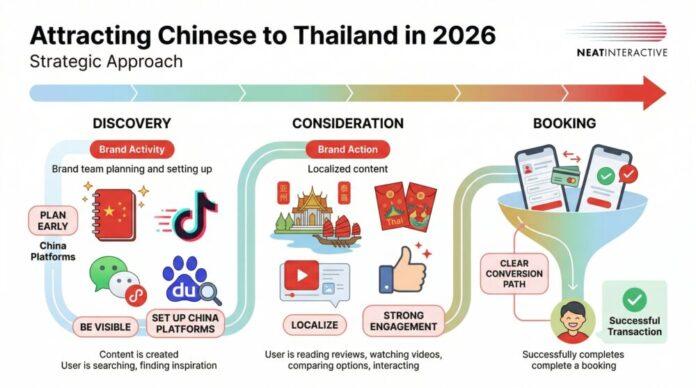
Chinese travelers typically begin researching destinations six to twelve weeks before departure. The strong arrivals recorded at the start of the year were largely influenced by digital discovery that took place last November and December.
The next major travel window will come in Q3, during the Mid-Autumn Festival period. Brands that begin activating campaigns in July will already be too late, as the influence window opens in late Q2.
Success in 2026 will depend on aligning marketing activity with the research cycle — not the holiday itself.
Market Share Is Being Won Inside China’s Digital Ecosystem
As regional competition intensifies, digital discoverability is playing a larger role in shaping destination choice.
Capturing this demand depends on visibility inside China’s domestic digital platforms. As rising travel costs encourage more short-haul travel, competition within the region is increasing — and brands must compete earlier in the decision journey.
Chinese consumers research travel decisions across a distinct ecosystem, including Xiaohongshu (Red Book) for peer validation, Douyin for inspiration, Weixin (WeChat) for brand credibility, and Baidu for search confirmation.
Localization Is Behavioral, Not Linguistic
For many Thai brands, the challenge is not intent, but execution. Each Chinese platform operates with its own content logic and user expectations. Xiaohongshu favors authentic, review-driven storytelling, while Douyin prioritizes high-frequency short-form video, and Baidu requires a search strategy fundamentally different from Google SEO.
“Many Thai brands assume that using the same images and translated captions from Instagram is enough to capture the attention of Chinese travelers,” says Anna Liu, Director of Chinese Services at Neat Interactive. “But Chinese discovery happens in a completely different ecosystem with very different content expectations. If you are not present during the research phase with localized content, you are effectively invisible — regardless of how strong your Western channels perform.”
Localization now means adapting to platform culture, algorithm behavior, and user patterns — not simply translating captions into Mandarin.
From Seasonal Campaigns to Structured China Roadmaps
The Chinese market remains influenced by travel periods and holidays, but marketing approaches are evolving. Campaigns are often planned one to two months ahead of key periods such as Chinese New Year, Songkran, and Labor Day. However, leading brands are shifting toward longer-term planning aligned with the full travel calendar.
Chinese outbound travel follows predictable peaks, including Lunar New Year (Q1), Labor Day (May), Mid-Autumn Festival (Q3), and Golden Week.
Brands gaining traction are planning backward from these windows — building visibility early and maintaining consistent presence throughout the year.
For Thai marketers, 2026 will be a test of strategic maturity as global conditions make long-haul travel more expensive and less predictable, Thailand’s ability to capture nearby Chinese demand will increasingly depend on how effectively brands influence decisions early in the digital journey.
The opportunity is clear: Thai brands that succeed will be those that plan earlier, localize more and align their strategies with how Chinese consumers actually discover and choose destinations.
[i] “6 million tourists boost economy”
https://www.bangkokpost.com/thailand/general/3205360/6-million-tourists-boost-economy
[ii] “Too soon to predict China tourism rebound”
https://www.bangkokpost.com/business/general/3206813/too-soon-to-predict-china-tourism-rebound
[iii] “Economic toll of war grows”
https://www.bangkokpost.com/business/general/3217544/economic-toll-of-war-grows

