
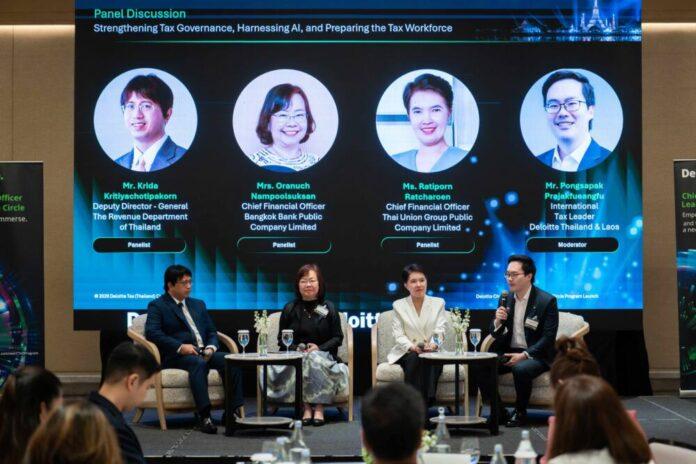
Deloitte Thailand has launched the Chief Tax Officer (CTxO) Leadership Circle, a new forum designed to bring senior tax leaders from public and private sectors together to exchange perspectives and explore the challenges and opportunities shaping the future of the tax function.
As organisations face an increasingly complex and fast-changing operating environment, tax leaders are now required to contribute well beyond compliance. From risk management and governance to digital transformation and long-term planning, the tax function is becoming an increasingly important source of strategic insight for leadership teams and boards.
The inaugural Leadership Circle brought together senior executives from Thailand’s leading organisations under the theme “Strengthening Tax Governance, Harnessing AI and Preparing the Tax Workforce”. The theme reflects the growing role of tax leaders as strategic advisers, helping their organisations navigate policy change, technological disruption and increasing stakeholder expectations.
The discussions focused on strengthening tax governance, exploring the opportunities AI presents for tax administration and decision-making, and developing the skills needed for the next generation of tax professionals. They also underscored the importance of continued dialogue between the public and private sectors as the tax landscape evolves.
Mr. Krida Kritiyachotipakorn, Deputy Director-General of the Revenue Department of Thailand, who delivered the keynote address at the event, said: “We are entering a transformative period in the tax profession, as new technologies such as AI reshape the relationship between taxpayers and tax authorities, building a foundation of greater transparency, efficiency and trust. Forums that bring together tax authorities, taxpayers and the tax profession are valuable in preparing all of us for what lies ahead.”
From the business perspective, these changes are also influencing how organisations approach tax as part of their broader financial strategy. Ms. Oranuch Nampoolsuksan, Chief Financial Officer at Bangkok Bank Public Company Limited, and a panelist at the event, said: “Tax decisions affect capital allocation, investor confidence, and ultimately the returns we deliver to shareholders. Tax is a complex consideration especially for companies in the financial services, where we are operating across multiple jurisdictions, product lines and regulatory frameworks. Organisations should seek to build tax planning into their financial strategy, alongside robust governance structures and data infrastructure, from the outset.”
Beyond financial strategy, tax governance is also becoming increasingly linked to transparency and accountability as stakeholder expectations continue to evolve.
Ms. Ratiporn Ratcharoen, Chief Financial Officer at Thai Union Group Public Company Limited, who was also a panelist, added: “As we work to build a more forward-looking and data-driven finance function, tax governance is an integral part of that agenda as more investors and stakeholders look for tax transparency. For Thai Union, where sustainability is central to our business strategy, we aim for our tax practices to reflect the same standards of accountability and transparency we apply across the rest of the organisation.”
The CTxO Leadership Circle forms part of Deloitte’s Chief Tax Officer Program, an invitation-only network for senior tax executives launched across Southeast Asia earlier this year. The program provides a platform for tax leaders to exchange insights, explore emerging challenges and strengthen the strategic role of tax within their organisations.
Mr. Subhabrata Dasgupta, Tax & Legal and CTxO Program Leader, Deloitte Thailand & Laos, said, “Tax leaders across Southeast Asia are increasingly being asked to weigh in on decisions well beyond the function, from transformation and technology investments to risk management and long-term strategy. We established the CTxO program to provide a trusted platform where senior tax professionals can exchange ideas, learn from one another and prepare for the changing demands of leadership. As the role of tax continues to expand, peer engagement and knowledge-sharing will be increasingly important in helping leaders deliver greater value.”

